
Coaching practice5 min read
The wheel of life: a coach's guide and template
How to use the wheel of life in coaching: what it measures, how to run the exercise step by step, questions to deepen it, and how to track it over time.

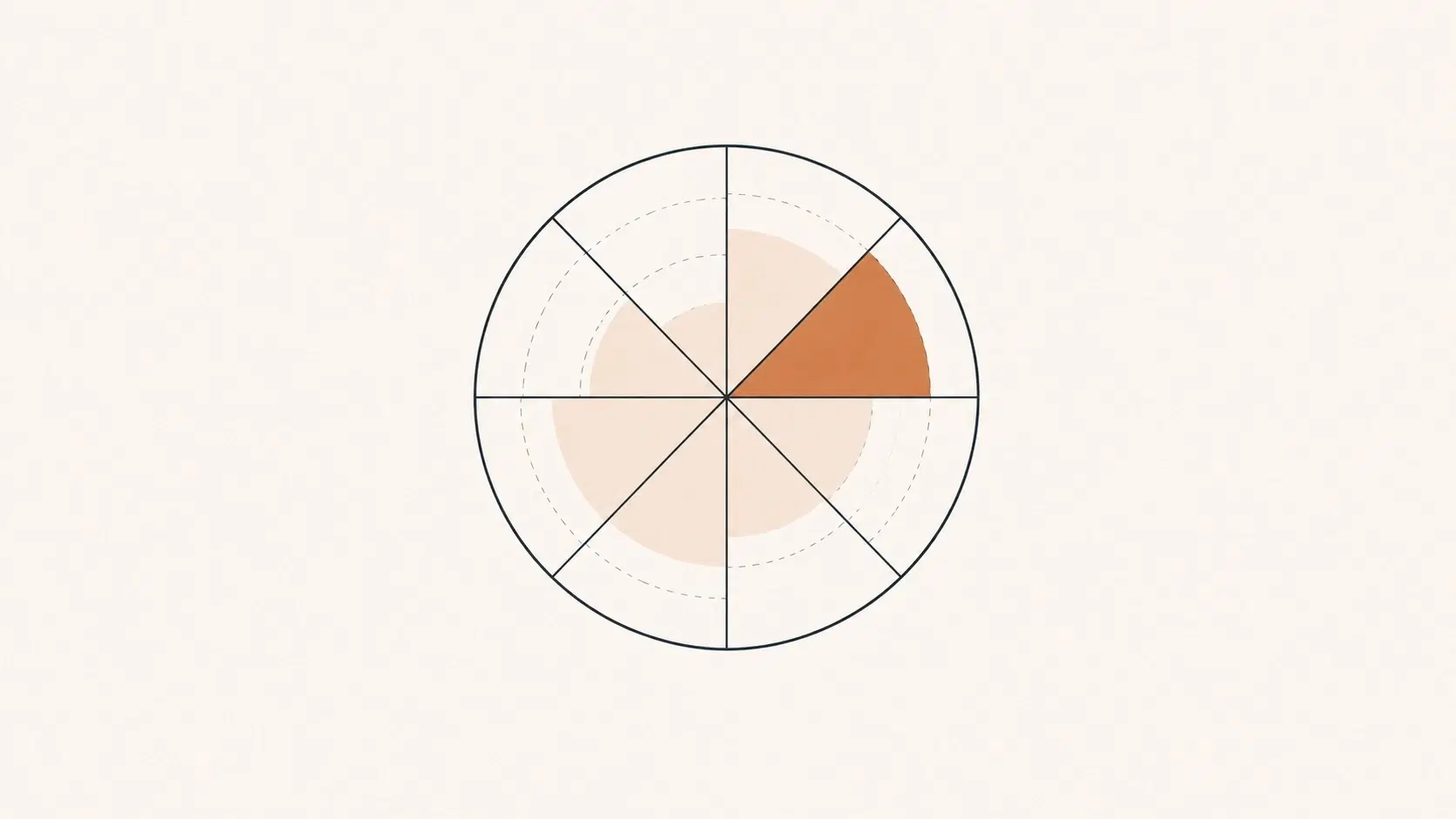
What is the wheel of life, and how do coaches use it?
In short: the wheel of life is a coaching exercise that divides a client's life into eight areas, has them rate satisfaction in each from one to ten, and plots the scores on a circle. The shape exposes imbalance instantly and gives the session a focus. Used once, it sets direction; revisited over months, it becomes a progress line you can measure.
The wheel of life is one of the most widely used tools in coaching, and for a simple reason: it turns a vague feeling of "something is off" into a picture a client can point at. Instead of talking in the abstract about balance, the client sees, in one circle, where their energy is thriving and where it has quietly drained away. That clarity is often the whole unlock. Where the wheel maps life areas, the Johari window maps self-knowledge, and the two pair naturally at the start of an engagement.
This guide covers what the wheel measures, how to run it well in a live session, the questions that turn scores into insight, the mistakes to avoid, and how to use it as an ongoing measure rather than a one-time gimmick.
Try it: you can run the exercise online with our interactive wheel of life, free and no sign-up, filled in online.
What the wheel of life measures: the eight areas
The classic wheel splits life into eight segments. You can adapt the labels to your client and niche, but this set works for most:
| Life area | The question the client is really rating |
|---|---|
| Career | Is my work meaningful and heading somewhere I want? |
| Finances | Do I feel secure and in control of my money? |
| Health | Am I looking after my body and energy? |
| Family and friends | Are my close relationships nourishing? |
| Romance | Am I content with my intimate relationship, or its absence? |
| Personal growth | Am I learning and becoming who I want to be? |
| Fun and recreation | Do I make room for play and rest? |
| Physical environment | Do my home and surroundings support me? |
Each area is scored from one at the centre to ten at the rim. When you connect the dots, a balanced life looks like a full, round wheel; an unbalanced one looks jagged, and that jaggedness is the conversation.
How to run the wheel of life exercise, step by step
The tool is simple; running it well is a skill. A clean sequence:
- Set the frame. Explain that there are no right answers and no judgement. The score is their honest read today, not a grade.
- Name the areas together. Confirm the eight labels fit their life. Swap one out if an area is irrelevant or if something vital is missing.
- Score quickly, on instinct. Ask them to rate each area one to ten without overthinking. First reactions are usually more honest than deliberated ones.
- Plot and pause. Draw or fill the wheel, then let them look at it in silence for a moment. The shape often lands before any words do.
- Explore the gaps, not the numbers. This is where coaching happens. Which low score surprises them? Which high score are they proud of? Where is the tension between two areas?
- Choose one area to move. Resist fixing everything. Ask which single area, lifted by two points, would most improve the rest, and what a small first step could be.
The numbers are the map. The session lives in steps five and six, which is exactly where a good coach earns their place.
Questions that turn scores into insight
A wheel with no dialogue is just a chart. The right prompts open it up. A few that reliably work:
- "What would a nine look like in that area, concretely?"
- "You scored career a four. What is the four made of, and what is missing to make it a five?"
- "Which of these areas feeds the others when it is high?"
- "If you did nothing, where would this area be in a year?"
These sit naturally alongside a broader repertoire; our guide to powerful coaching questions goes deeper into building that muscle. The wheel pairs especially well with a goal-setting framework afterwards, such as the GROW coaching model or SMART goals, to turn the chosen area into an actionable plan.
Common mistakes to avoid
The wheel is easy to use and easy to misuse. Watch for these:
- Chasing a perfect circle. A round wheel is not the goal. A client may happily score fun low right now because they are pouring energy into a launch. Balance is contextual.
- Rushing to solutions. The instinct to fix the lowest score immediately skips the insight. Sit with the shape first.
- Treating it as a test. If the client feels graded, the scores turn defensive and useless.
- Using it once and forgetting it. A single wheel is a snapshot. Its value compounds when you return to it.
From snapshot to progress: tracking the wheel over time
The most underused move with the wheel of life is the simplest: run it again. Re-scoring the same eight areas every three to six months converts a one-off diagnostic into visible progress, and few things motivate a client like seeing a four become a seven in their own hand.
The practical obstacle is memory. To compare wheels, you need last quarter's scores, the context around them, and what the client committed to, all still at hand when the next session comes. That is precisely the thread that gets lost when a client's history is scattered across notebooks and documents, a problem we cover in how to measure client progress.
This is the quiet work Klarity is built to carry: it holds the memory of each client across sessions, so when you reopen the wheel months later, the previous scores, the commitments and the story around them are already there. You walk in with the briefing before every session instead of reconstructing it. You can start free and let the tool remember the numbers so you can stay with the person.
Frequently asked questions
What is the wheel of life in coaching?
The wheel of life is a visual coaching tool that splits a client's life into eight areas, such as career, health and relationships. The client rates their satisfaction in each area from one to ten, and the scores are plotted on a circle. The resulting shape makes imbalance visible at a glance and gives the coaching conversation a clear starting point.
How do you use the wheel of life in a session?
Name the eight areas together, ask the client to score each one from one to ten based on their current satisfaction, then plot the scores. Spend most of the session not on the numbers but on the gaps: which area, if it moved up two points, would change the most, and what a first step might look like. The wheel is the map, not the destination.
Is the wheel of life only for the first session?
No. It works well early to set direction, but its real power shows when you revisit it every few months. Re-scoring the same wheel turns a one-off snapshot into a visible progress line, and gives both coach and client concrete evidence of what has shifted.
What if memory were to build itself?
Klarity prepares your sessions and keeps the thread of every client, for you.
Read next
All articlesCoaching practice
SMART goals in coaching: how to use them, and their limits
How to set SMART goals in coaching: what each letter means, how to shape a client's goal step by step, a worked example, and when SMART gets in the way.
Coaching practice
GROW coaching model: a practical step-by-step guide
How to use the GROW coaching model effectively? The four stages, example questions for each phase, its limits, and how to integrate it without becoming rigid.
Coaching practice
Johari window in coaching: a practical guide and template
How to use the Johari window in coaching: the four quadrants, running the exercise in a session, shrinking a client's blind spots, and a ready template.