
Coaching practice6 min read
GROW coaching model: a practical step-by-step guide
How to use the GROW coaching model effectively? The four stages, example questions for each phase, its limits, and how to integrate it without becoming rigid.

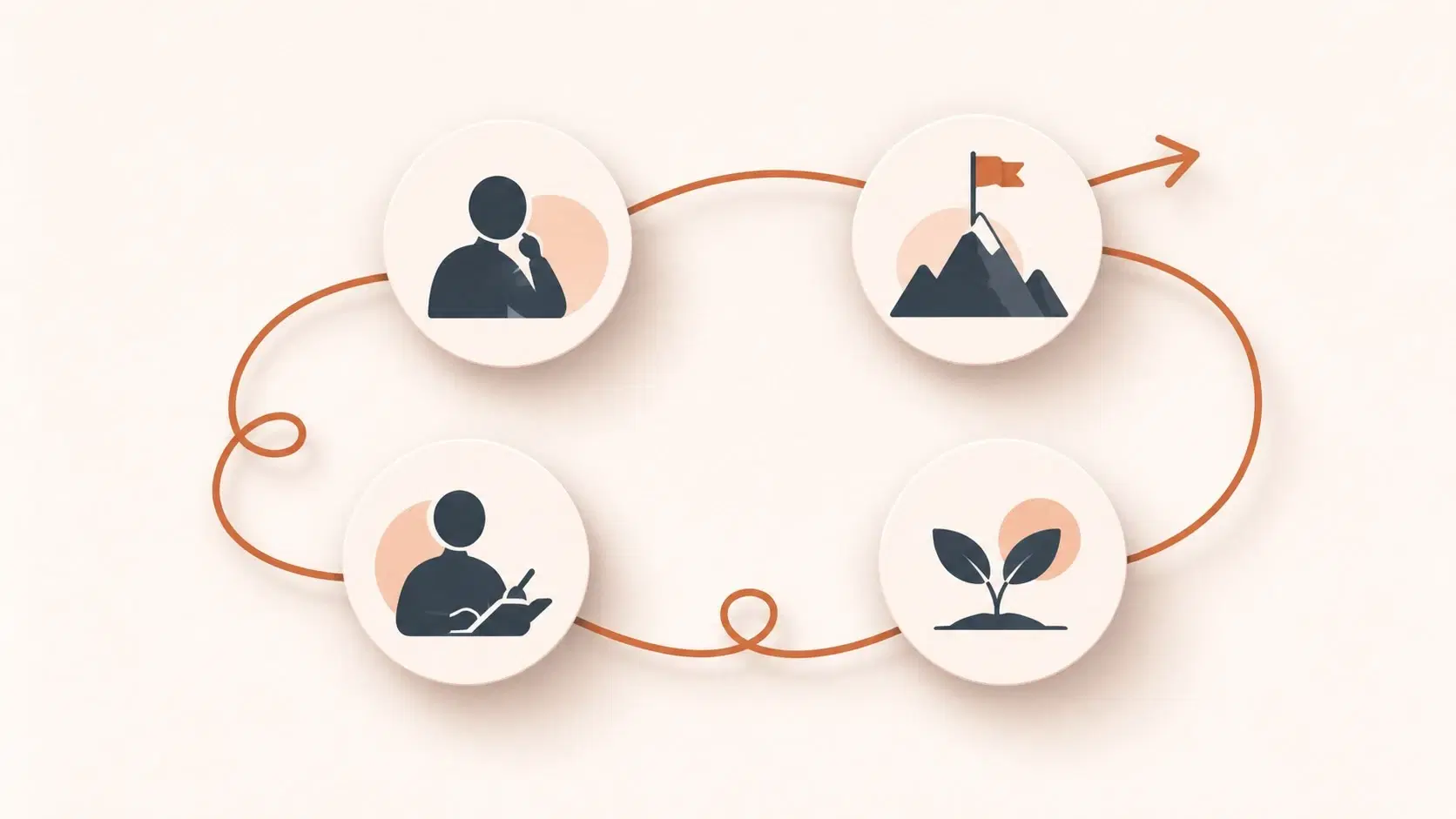
The GROW model: a framework, not a formula
In short: the GROW model structures a coaching conversation in four stages, Goal, Reality, Options, Will, developed in the 1980s by Graham Alexander and popularised by John Whitmore. Its strength is simplicity; its risk is being applied as a rigid checklist rather than a conversational compass you can move through in any order.
The GROW model is probably the most widely known coaching framework in the world. Developed in the 1980s by Graham Alexander and brought to a wide audience by John Whitmore, it structures a coaching conversation around four stages: Goal, Reality, Options, and Will. Its strength is its simplicity; its risk is being applied as a checklist rather than a conversational compass.
This article walks through the GROW model stage by stage (with concrete example questions for each phase), examines what the framework does well and where it falls short, and suggests a way to integrate it into your practice without becoming a prisoner of the sequence.
Goal: clarifying what the client wants
The first stage is about defining what the client wants to achieve. Two levels usually coexist: the session goal (what we're working on today) and the engagement goal (the larger outcome the client is moving toward over time). Making that distinction explicit early on prevents a lot of confusion, especially in the first few sessions. A visual diagnostic like the wheel of life can help surface which area a meaningful goal should come from.
Useful questions for this stage:
- "What would you like to have achieved by the end of this session?"
- "What's the bigger goal you're working toward?"
- "How will you know when you've reached it?"
- "What would achieving this give you?"
The common mistake is moving through this phase too quickly. A vague goal ("feel better about things" or "make progress on the project") doesn't give enough anchor for the conversation that follows. The clarification work here is often the first real movement of a session.
Reality: mapping the current situation
This stage invites the client to describe where they actually are, without filtering. The point isn't diagnosis or problem-solving yet; it's building an honest, clear picture of the present. The coach helps the client see what is there, including what they tend to minimize or avoid naming.
Useful questions for this stage:
- "Where are you today in relation to that goal?"
- "What's actually happening right now?"
- "What obstacles are you running into?"
- "What have you already tried?"
- "What's keeping you from moving forward?"
This is often the stage where powerful coaching questions have the most impact: a question that touches an unspoken resistance or an overlooked angle can shift the entire session that follows.
Options: expanding the field of possibilities
The Options stage is not a brainstorming exercise. It's an exploration of what might be possible, driven by curiosity rather than problem-solving mode. The coach resists the pull to offer solutions; the work here is to help the client widen their view, not narrow it toward the "right" answer.
Useful questions for this stage:
- "What are the different ways you could approach this?"
- "What haven't you considered yet?"
- "If you knew you couldn't fail, what would you do?"
- "What would someone you admire do in your situation?"
- "Which option feels most alive to you, and why?"
The plural matters: the goal is to generate several possibilities before committing to one. The aim isn't to find the best option inside the session, but to leave the client with a genuine sense of choice.
Will: anchoring commitment
The final stage turns exploration into decision. It isn't about wrapping up the session politely; it's about ensuring the client leaves with a clear, realistic commitment that belongs to them. The commitment made here is the raw material of the next session.
Useful questions for this stage:
- "What's the first thing you're going to do?"
- "What will you commit to before we next meet?"
- "On a scale of one to ten, how motivated do you feel about this?"
- "What could get in the way, and how will you handle it?"
- "What do you want me to hold for you from today's session?"
The motivation scale question is often revealing: a client who answers five out of ten is signaling an unspoken obstacle. That's the moment to name it before closing: a brief return to Reality before the commitment is made.
The limits of the GROW model
GROW is a framework, not a mandatory sequence. A few limitations worth keeping in mind:
The order isn't always linear. In practice, a session might start in Reality and circle back to Goal, or move several times between Options and Reality before anything is clear. The model is a reference point, not an algorithm to execute.
It assumes a goal is available from the start. Some clients arrive without one; they need space before they can define what they want. Pushing the Goal phase too early in those cases can shut things down rather than open them.
It is action-oriented. GROW works very well for professional development goals and concrete decisions. It is less suited to identity-level transformations or processes of grief and loss, which require a different pace and a different kind of attention.
It can mask the relationship. Applied mechanically, GROW creates the impression of structure without real presence to what is actually happening. A framework that reassures the coach but constrains the client is not serving anyone well.
Using GROW without being ruled by it
The best way to use the GROW model is to internalize its logic so thoroughly that you no longer apply it consciously. You hold the goal, stay curious about reality, open up options, and anchor commitment, but you don't follow the steps in sequence when the session is going somewhere else.
Combined with solid session preparation, GROW becomes an unobtrusive organizer: you know where you are in the conversation without the client experiencing it as a protocol. What makes the model genuinely useful over time is the ability to track how it unfolds across an engagement: which goal has been active for how many sessions, which options were explored and which were set aside, what commitments were made and whether they held. That's where measuring client progress comes in: turning the GROW framework into a living memory of an ongoing engagement.
Keeping the thread from session to session
The GROW model reaches its full potential over the arc of an engagement, not in a single session. The goal defined in session one should be retrievable in session four; the options explored in session two may feed session five; the commitment made in session three needs to be revisited in session four. That continuity depends on reliable records.
This is where Klarity can take the load off. When each session is captured and automatically summarized, the pre-session briefing gives you back the client's goal, what has shifted, what remains open, without you having to reconstruct the thread yourself. The GROW model stops being a one-session framework and becomes the backbone of a full engagement, carried faithfully across every meeting. Hosted in France, never using your session data to train third-party AI models, with strict isolation between coaches.
If having that thread always available before each session sounds like something that would change how you work, discover Klarity: a longitudinal memory of every engagement, ready before each session.
Frequently asked questions
What does GROW stand for?
GROW is an acronym for the four stages of a coaching conversation: Goal (what the client wants), Reality (the current situation), Options (the possibilities), and Will (the commitment to act).
Who created the GROW model?
The GROW model was developed in the 1980s by Graham Alexander and brought to a wide audience by John Whitmore, who popularised it through his work on performance coaching.
Do you have to follow the GROW stages in order?
No. GROW is a reference point, not an algorithm. In practice a session may start in Reality and circle back to Goal, or move several times between Options and Reality. The best use is to internalise its logic and not follow the sequence when the conversation is going somewhere else.
What if memory were to build itself?
Klarity prepares your sessions and keeps the thread of every client, for you.
Read next
All articlesCoaching practice
SMART goals in coaching: how to use them, and their limits
How to set SMART goals in coaching: what each letter means, how to shape a client's goal step by step, a worked example, and when SMART gets in the way.
Coaching practice
The wheel of life: a coach's guide and template
How to use the wheel of life in coaching: what it measures, how to run the exercise step by step, questions to deepen it, and how to track it over time.
Coaching practice
Johari window in coaching: a practical guide and template
How to use the Johari window in coaching: the four quadrants, running the exercise in a session, shrinking a client's blind spots, and a ready template.