
Coach wellbeing6 min read
Coach mental load: where it comes from and how to ease it
A coach's mental load comes mostly from holding every client's story in your head. How to recognize it, offload it, and set sustainable limits before burnout.

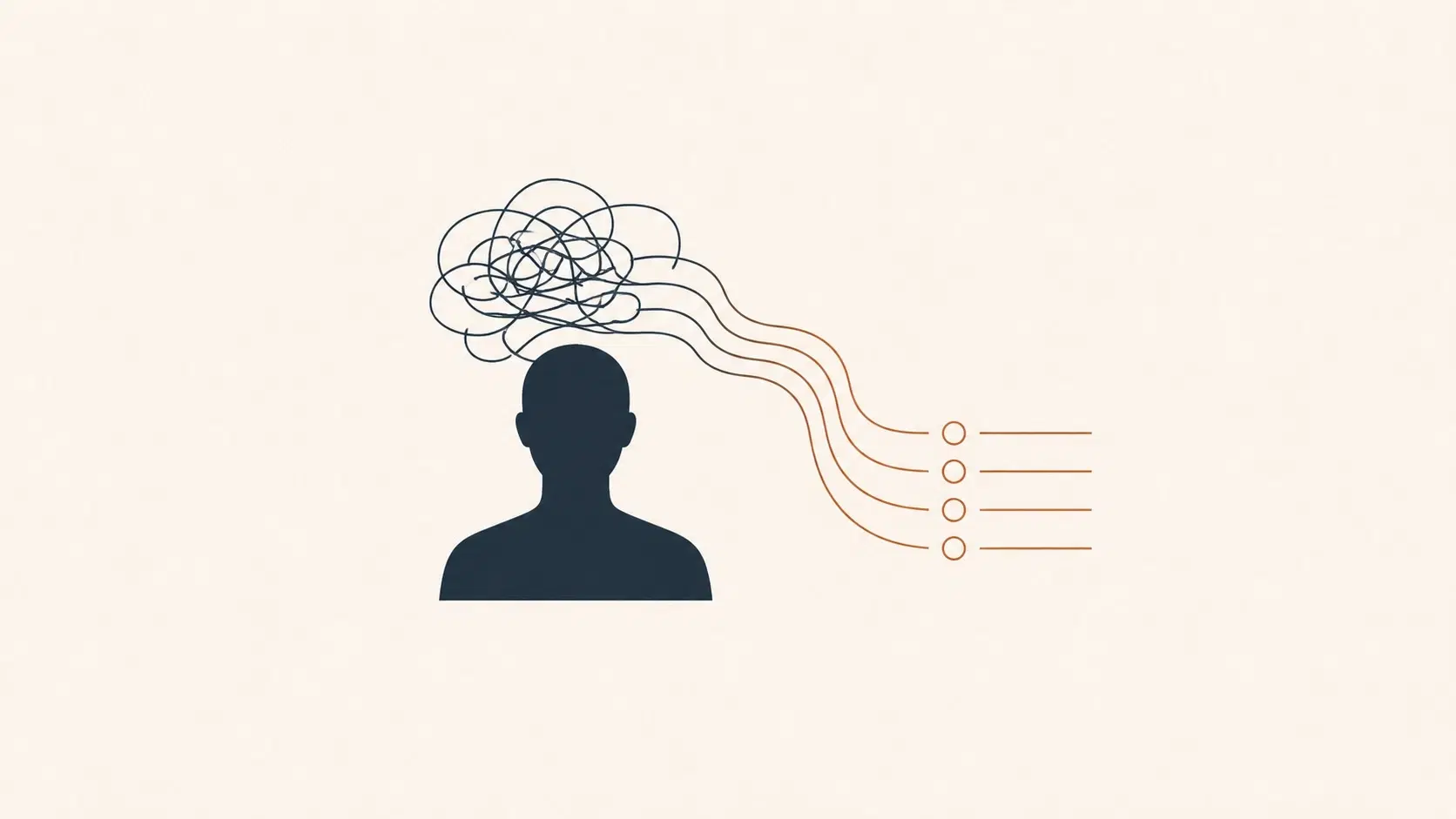
Where does a coach's mental load come from, and how do you ease it?
In short: a coach's mental load comes far less from the sessions themselves than from everything around them: holding in your head what each client said, decided and left unresolved, keeping the thread of several engagements in parallel, and staying mentally available long after the billed hours end. You ease it by offloading the factual memory into a reliable system, setting limits on your availability, and keeping a space where you can set down what weighs on you.
Mental load is one of the least visible forms of fatigue in the profession. A coach can have only fifteen hours of sessions a week and still feel drained, not from the volume of hours, but from all the cognitive work that no one sees. That work appears on no calendar and on no invoice, which makes it all the harder to recognize and address.
This article names that load precisely, identifies its main source, then sets out concrete levers to ease it. The point is not to work harder on yourself, but to stop asking your brain to do work a system can carry instead.
What is mental load when you're a coach?
Mental load is the invisible, permanent part of the work, the part that keeps running once the session is over. For a coach it takes a particular shape: you have to remember each person you accompany as a continuous thread, while the sessions themselves are weeks apart.
In practice, that means recalling before a meeting what played out last time, not confusing two clients in similar situations, and keeping in mind the commitments made and the sensitive topics not to forget. It is also the diffuse anticipation of upcoming sessions, a client's words resurfacing in the shower, and the feeling that you must hold it all in your head to stay equal to the work.
This load is real even when the calendar looks light. That is exactly what makes it a trap: it is not measured in hours, so you tend to deny it, until it shows up as tiredness, irritability, or an inability to switch off.
Why it stays invisible, and gets neglected
Mental load goes unseen because it occupies no slot in the schedule. A coach who structures their practice seriously will size the number of sessions, but rarely the work of memory and anticipation that connects them. Yet that work is what separates a real accompaniment from a string of disconnected conversations.
There is also a widespread belief in the profession: that a strong memory of clients is a personal quality of the coach, almost a mark of seriousness. Admitting you do not retain everything would look like a flaw. This belief pushes coaches to carry it all in their head, and turns a normal cognitive limit into constant pressure.
No human brain is built to hold the detailed thread of twenty or thirty relationships in parallel over several months. Acknowledging that limit is not a confession of weakness: it is the starting point of any realistic solution.
The real culprit: holding every client's memory in your head
For most solo coaches, the dominant source of mental load is memory carried in the head. As long as the recollection of sessions lives only in the coach's mind, it consumes attention in the background, exactly like a dozen browser tabs left open, attention that is then no longer available to listen to the client.
This load grows non-linearly with the number of clients. At five clients you can still manage. At fifteen, the smallest forgotten detail breeds a diffuse worry, and preparing each session becomes an exercise in memory reconstruction. It is one of the tipping points you meet as soon as you try to manage many coaching clients without losing quality.
The cost is not limited to fatigue. Memory held in the head is also memory that distorts: you keep what struck you, not necessarily what mattered to the client. Mental load and information loss therefore advance together, and both weigh on the relationship.
Easing the load by offloading factual memory
The most effective lever is to move factual memory out of your head and into a reliable system. The idea is not to become a bureaucrat of your own practice, but to decide that anything that can be written down no longer has to be remembered.
In practice this runs through session notes kept consistently, structured records rather than a scattered notebook, and above all a moment of review just before each meeting. The simple act of preparing a session from a written trace, instead of digging through your memory, is enough to dissolve much of the tension that builds before a client.
This is exactly the logic behind Klarity: the platform builds a longitudinal memory of each client, session after session, and hands you a concise briefing before every meeting. The factual part of memory (what was said, decided, left unresolved) is carried by the tool, which gives the coach back the headspace and presence that part used to consume.
Setting limits on mental availability
Offloading memory is not enough if your mind stays permanently switched on to your clients. Mental load also feeds on the absence of a boundary between work time and the rest. A few simple limits change a great deal.
Deciding on a maximum number of clients, accounting for the invisible load and not only the session hours, is probably the most structuring limit. Setting windows where you check neither messages nor notes, and a closing ritual at the end of the day that signals the mental work has stopped, helps the brain let go. These limits do not reduce your commitment: they make it sustainable over time.
When the load becomes a signal to heed
A mental load that settles in for the long term, to the point of stopping you from switching off or eroding the pleasure of the practice, is a signal not to ignore. It can precede professional burnout, especially in a job where you receive other people's difficulty.
That is precisely the role of a coaching supervision space: to set down what weighs on you, gain perspective on your practice, and tell apart what belongs to organization from what calls for support. Easing mental load is therefore both a question of tooling and a question of professional hygiene.
If you would like to entrust the factual memory of your engagements to a system designed for coaches, rather than to your head alone, you can discover Klarity.
Frequently asked questions
What is mental load for a coach?
It is the invisible, ongoing cognitive work that surrounds your sessions: remembering what each client said, decided and left unresolved, anticipating upcoming meetings, and holding the thread of several engagements at once. It never shows up on a calendar and is never billed, yet it occupies you continuously, including well outside your practice hours.
Is mental load a sign that burnout is coming?
Not necessarily, but it is a signal worth taking seriously. A sustained mental load that stops you from switching off between sessions and eats into your sleep or attention is one of the factors that lead to professional burnout. Addressing it early, by offloading what can be offloaded and setting clear limits, is a form of prevention.
How can coaches reduce their mental load?
By no longer holding everything in your head. A reliable client memory system (consistent session notes, structured records, a briefing before each session) takes the factual part off your mind. Add clear limits on availability, a client count that matches your capacity, and a supervision space where you can set down what weighs on you.
What if memory were to build itself?
Klarity prepares your sessions and keeps the thread of every client, for you.
Read next
All articlesCoaching practice
Taking notes in coaching sessions: presence vs memory
Should you take notes during a coaching session? How to keep a record without breaking the connection, and what AI note-taking really changes for coaches.
Coaching practice
How to prepare a coaching session: a simple method
A repeatable pre-session routine for coaches: review context, check open actions, frame two hypotheses, and show up fully present every time.